---
title: "Agents and terminals"
description: "Durable Moor sessions, the multiplexer, terminal rendering, attention signals, native agent chat, and fleet controls"
---
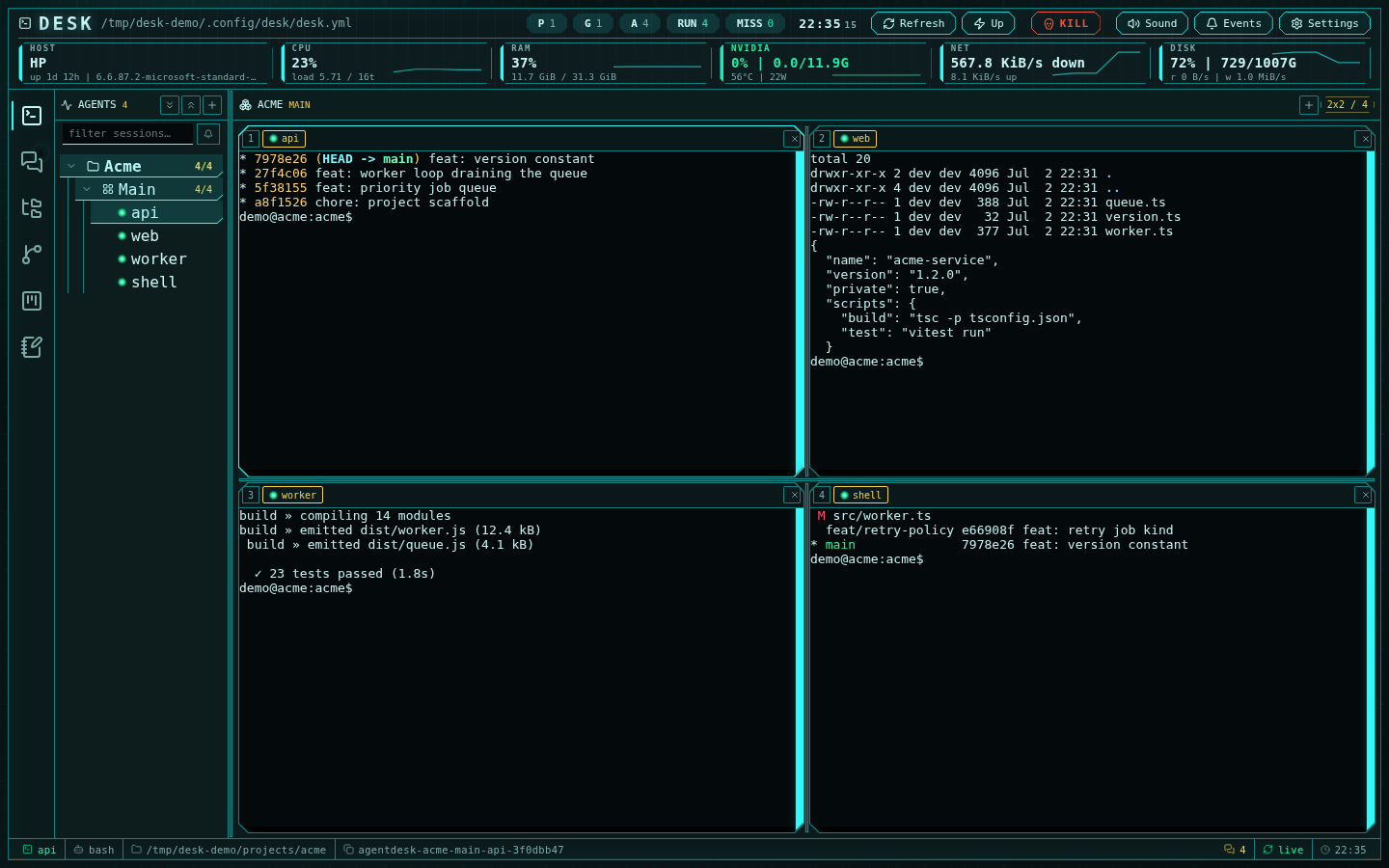
The agent multiplexer is Desk's core surface. It lets one operator supervise
many coding-agent sessions without losing process lifetime, terminal state, or
attention signals.
 ## Supported agents
Desk has a built-in integration for each of:
- Claude Code
- OpenAI Codex
- OpenCode
- Qwen Code
- Kimi Code
- Grok
- bash (or any custom command)
"Integration" here, not "profile". **Profile** means one thing in Desk: a named
provider *account* a session runs under — see
[agent profiles](/configuration#agent-profiles).
Each integration prepares that CLI's launch command, environment, resume
metadata, and state-reporting hooks. Sessions for agents that support it can be
launched with permission bypass enabled from a checkbox in the session form.
Resume behavior is agent-specific: Claude, Qwen, Kimi, and Grok session ids
arrive through their hooks, Codex ids are read from its own session records,
and OpenCode sessions are recaptured from the CLI's session list with a picker
on restart. Every captured id is validated before reuse; an explicit `resume`
in the manifest works for all of them.
Claude Code, Codex, and OpenCode sessions can render as a native chat surface
(`uiMode: native`); Qwen, Kimi, and Grok are terminal-only;
bash and custom-command sessions render as terminals. Each SDK-backed session
can instead run in terminal mode — the raw CLI TUI in a terminal cell — by
setting `uiMode: terminal` on the session, and the edit modal switches a
session between modes in place.
## The native chat surface
## Supported agents
Desk has a built-in integration for each of:
- Claude Code
- OpenAI Codex
- OpenCode
- Qwen Code
- Kimi Code
- Grok
- bash (or any custom command)
"Integration" here, not "profile". **Profile** means one thing in Desk: a named
provider *account* a session runs under — see
[agent profiles](/configuration#agent-profiles).
Each integration prepares that CLI's launch command, environment, resume
metadata, and state-reporting hooks. Sessions for agents that support it can be
launched with permission bypass enabled from a checkbox in the session form.
Resume behavior is agent-specific: Claude, Qwen, Kimi, and Grok session ids
arrive through their hooks, Codex ids are read from its own session records,
and OpenCode sessions are recaptured from the CLI's session list with a picker
on restart. Every captured id is validated before reuse; an explicit `resume`
in the manifest works for all of them.
Claude Code, Codex, and OpenCode sessions can render as a native chat surface
(`uiMode: native`); Qwen, Kimi, and Grok are terminal-only;
bash and custom-command sessions render as terminals. Each SDK-backed session
can instead run in terminal mode — the raw CLI TUI in a terminal cell — by
setting `uiMode: terminal` on the session, and the edit modal switches a
session between modes in place.
## The native chat surface
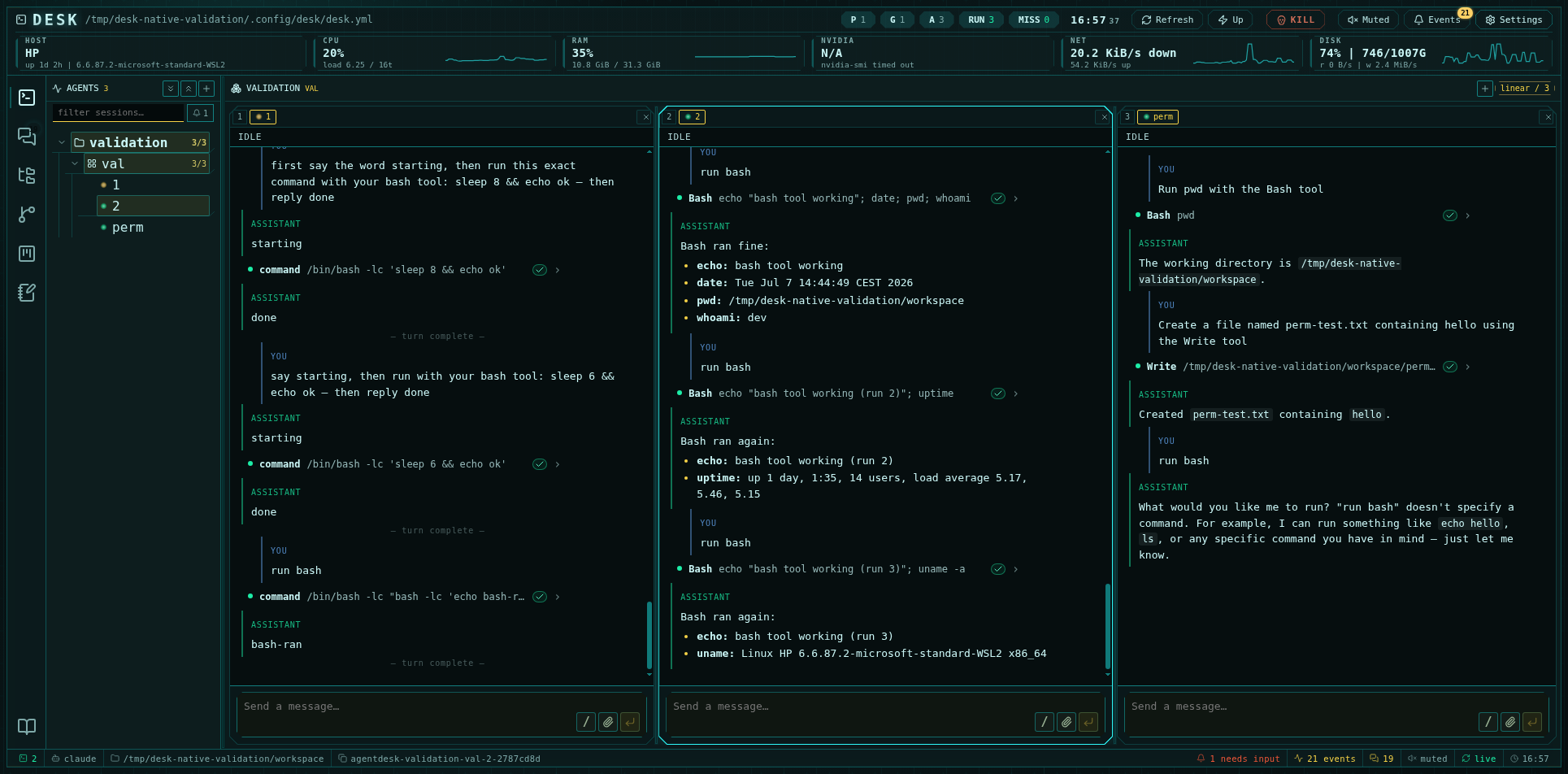 In native mode Desk speaks to the agent through its SDK and renders the
conversation itself, instead of showing the CLI's terminal UI:
- **Transcript** — user and assistant turns render as markdown with
role-accented rows and turn separators. Long feeds are virtualized, so
thousand-row histories scroll smoothly; an unread marker shows what arrived
since you last looked, and a jump pill returns you to the live tail after
scrolling up.
- **Tool calls** — every tool invocation is a compact row with a status dot,
elapsed time, and a disclosure that opens the exact input and output the
agent saw. Sub-agent activity nests under the tool row that spawned it.
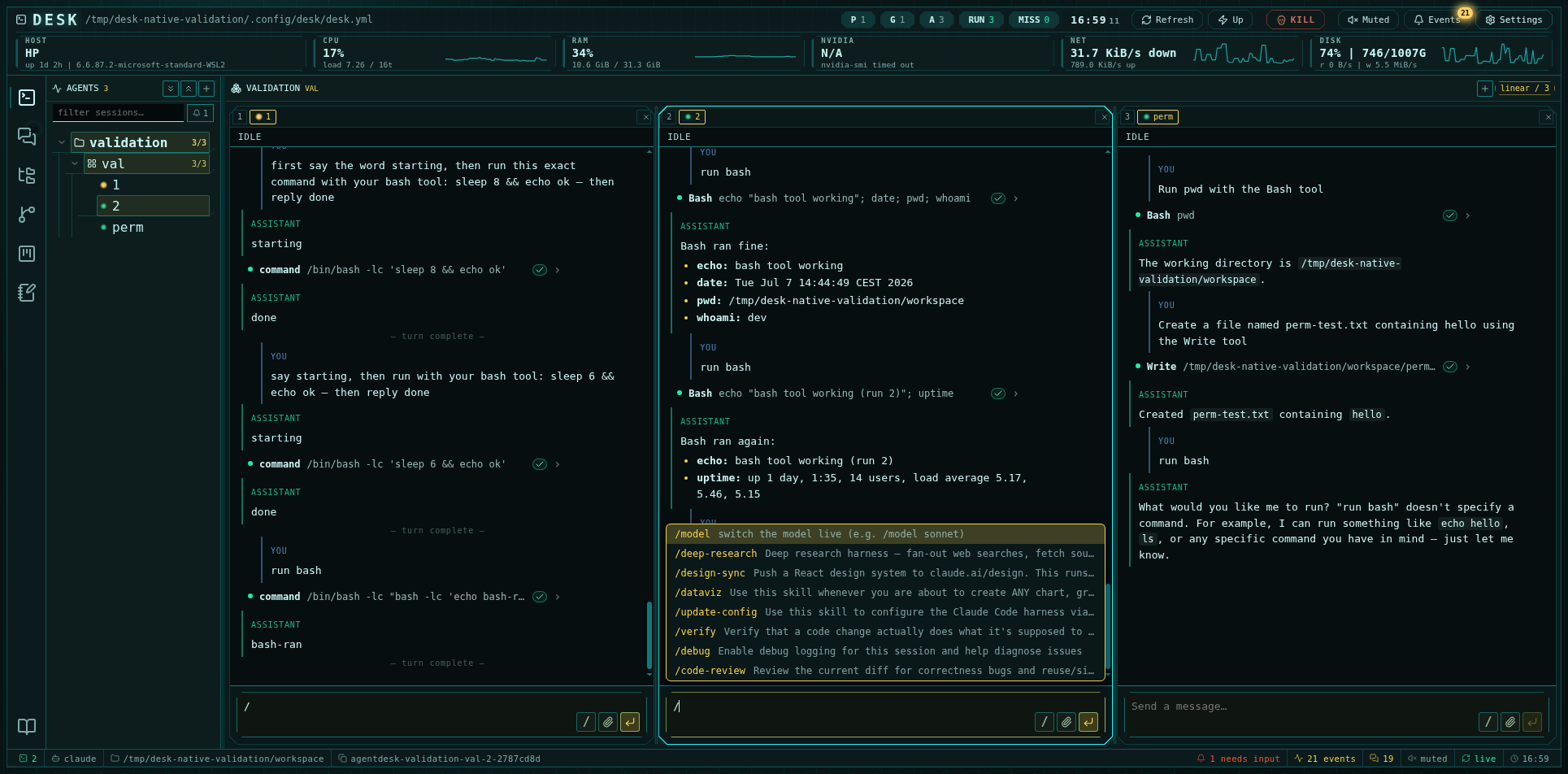
- **Composer** — a resizable input with file attachments (button, paste, or
drag-and-drop), a slash-command palette fed by the commands the agent
actually advertises, and a Send control that becomes Stop while a turn
runs. A pulsing indicator marks the whole time the agent is working —
from the moment you send until the reply, including tool execution.
- **Permissions** — approval requests dock above the composer with the
proposed command or file diff, and resolve inline.
- **Continuity** — transcripts survive reloads and browser switches: the
server keeps the session's event history and replays it to every surface,
and the agent process itself lives in its Moor session, so nothing
dies with the tab.
In native mode Desk speaks to the agent through its SDK and renders the
conversation itself, instead of showing the CLI's terminal UI:
- **Transcript** — user and assistant turns render as markdown with
role-accented rows and turn separators. Long feeds are virtualized, so
thousand-row histories scroll smoothly; an unread marker shows what arrived
since you last looked, and a jump pill returns you to the live tail after
scrolling up.
- **Tool calls** — every tool invocation is a compact row with a status dot,
elapsed time, and a disclosure that opens the exact input and output the
agent saw. Sub-agent activity nests under the tool row that spawned it.
- **Composer** — a resizable input with file attachments (button, paste, or
drag-and-drop), a slash-command palette fed by the commands the agent
actually advertises, and a Send control that becomes Stop while a turn
runs. A pulsing indicator marks the whole time the agent is working —
from the moment you send until the reply, including tool execution.
- **Permissions** — approval requests dock above the composer with the
proposed command or file diff, and resolve inline.
- **Continuity** — transcripts survive reloads and browser switches: the
server keeps the session's event history and replays it to every surface,
and the agent process itself lives in its Moor session, so nothing
dies with the tab.
 Messages sent from [channels](/channels) reach native sessions through the
same injection path the composer uses, so agent-to-agent delivery works
identically in both modes.
## Durable Moor sessions
Every managed session runs under a Moor holder keyed by its durable
`sessionId`. This gives Desk
three important properties:
- closing the browser does not kill the agent
- restarting Desk reattaches to running work
- sessions can be captured, restarted, or booted without changing the UI model
The browser terminal is a view of a Moor-backed process, not the process
owner. Attaching never resurrects a dead session — booting is always an
explicit action — so an externally killed agent shows as missing instead of
being silently restarted.
## The sidebar
The sidebar is a projects → groups → sessions tree:
- Session rows show a live status lamp: running, needs input (pulsing), or
missing. Attention bubbles up to collapsed group and project rows.
- Group rows show running/total counts and a boot-missing action when some
sessions are down.
- A filter row narrows the tree by session, group, or project substring, and
a needs-input chip filters to sessions waiting on you, with a count.
- Projects, groups, and sessions reorder by drag and drop, and a session can
be dragged into another group to move it. Order persists to the manifest.
- Row actions cover add, edit, info, restart (with confirmation — it kills the
running agent), and delete.
## Groups and layouts
Groups organize agents by project, lane, or responsibility. Layout kinds are
`1x1`, `2x2`, `3x3`, `4x4`, `linear` (all cells in one row), and `custom`,
with 1–16 cells. The layout badge in the multiplexer header switches kinds
in place; +/− buttons add and remove cells.
Cells are resizable: drag the separators and the split proportions persist per
group in the manifest, restoring exactly after a reload. Sessions map to cells
by assignment — drag a session tab onto a cell, or tap an empty cell to assign
one from an inline picker.
Group switches are cheap by design: recently visited groups stay mounted with
live cells (a warm budget of roughly 40 sessions on desktop), so flipping
between groups opens no new connections and loses no transcript or terminal
state.
## Terminal rendering
Terminal cells — bash sessions, custom commands, and SDK agents running with
`uiMode: terminal` — use xterm.js in the browser and a server-side terminal
daemon for transport. One binary WebSocket per browser tab carries the tab's
terminal surfaces. A hidden surface keeps its channel but relinquishes input,
resize, and output-delivery authority until reveal. The daemon owns the Moor
holder connections, fans each session to every viewer (a desktop tab and a
phone see the same process), retains one bounded shared output suffix, and
catches a same-channel reveal up with one contiguous packet when its cursor and
geometry revision are still valid. A gap or revision change falls back to a
current-screen snapshot; retained history remains available through the frozen
scrollback viewer. Output streams only to visible cells. Unsubscribe is reserved for actual
surface removal or transport loss. `SUBSCRIBE` carries the fitted geometry for
new and reconnected channels; later `RESIZE` frames are sent and applied only
when that geometry changes, so revealing a cell cannot advance the terminal
revision solely because its layout observer repeated the same dimensions.
Rendering uses hardware WebGL where available, under a shared budget of 8
contexts — cells beyond the budget (and machines with software-only GL) fall
back to the DOM renderer. Hidden cells release their context to visible ones,
and only the focused cell blinks its cursor.
File paths printed by an agent are links: click one to open it in the editor.
Relative paths resolve against the folder the session was launched in (a `cd`
inside the session is not tracked), and a guessed path that is not on disk is
refused with one notice instead of opening.
Scrollback: append-style agent output scrolls natively in the live buffer,
which already carries the daemon's retained history (colors and layout
preserved, native scrolling and selection); full-screen TUI programs get
application-owned scrolling with agent-aware key encoding. A custom scroll
rail on the cell edge tracks position — except on Grok panes, whose TUI draws
its own scrollbar, so Desk's rail steps aside instead of competing with it.
Terminals self-heal: if the connection drops, cells show a reconnect overlay
and automatically re-arm on tab return, network recovery, or the first
successful poll after an outage — waking a laptop reconnects the whole wall
without a click.
## Attention signals
Session state comes from the agent itself. Desk installs lifecycle hooks into
each supported CLI, and those hooks post typed events — turn opened, turn
finished, tool started, tool ended, permission requested — to the daemon, which
owns one canonical state per session. Native-mode sessions report the same
facts through the SDK. Desk does not read the terminal to work out what an
agent is doing, and a session whose hooks have not fired reads as **unknown**
rather than being guessed at.
That state surfaces as:
- a pulsing lamp on the session row and its collapsed ancestors,
- an entry in the events drawer with kind filters, unread tracking, and
mark-all-read,
- an attention sound (respecting the mute toggle).
Typing into a session clears its attention state; acknowledged events stop
lighting up.
Attention is for the operator, not for the delivery engine: channel messages
are delivered whatever a session's activity is, because every agent CLI
buffers typed input until its turn ends.
If a session sits on `unknown`, run `desk hooks install` and restart it — hooks
are read at launch, so a session started before they existed never reports.
## Command palette and keyboard
`Ctrl+K` opens the session quick-switcher — attention-needing sessions first,
then recent, then tree order, fuzzy-matched across session, group, project,
and session ids. `Ctrl+Shift+K` opens it even while a terminal has focus.
`Ctrl+Alt+1..9` focuses cell N; `Ctrl+Alt+←/→` cycles sessions tree-wide.
See [Keyboard shortcuts](/keyboard-shortcuts) for the full map, including
in-terminal copy, paste, and find.
## The header
The header carries fleet stats (project/group/agent counts, RUN and MISS
chips — MISS is clickable and boots the missing sessions), host telemetry
cells with sparklines (CPU, RAM, GPU, network, disk), a clock, and the
toolbar: Refresh, Up (start all missing), the emergency kill switch, sound
toggle, events drawer, and settings. The config-path button opens `desk.yml`
directly in the editor. On phones the toolbar collapses into a burger menu
and telemetry into a compact strip.
## Mobile
Below 860 px the active subsystem owns the screen: sidebars become slide-over
drawers with a tap-to-close scrim, and the multiplexer becomes a swipeable
one-cell-per-screen pager whose indicator diamonds are state-tinted — the
active cell expands into a named pill, and attention pulses so you can see
who is screaming from the pager alone.
## Operational controls
- **Refresh** re-reads fleet state; a 2-second pulse keeps liveness, attention,
and telemetry current in between (paused while the tab is hidden), so an
externally killed session flips to missing within a tick — no manual refresh.
- **Up** starts every missing session from the manifest without touching
running ones; groups and individual cells have their own boot actions.
- **Restart** kills and relaunches one session (confirmed first).
- **KILL** is the emergency stop: it kills **all** Claude Code and Codex CLI
processes found by the host sweep and retires every configured Moor session.
It confirms with an alarm before acting. Use it as a last resort, not a
routine control.
The status bar keeps the selected session's identity (agent, working
directory, copyable session id) and app-wide signals — agents needing input,
unread events and messages, mute, and sync state — visible at all times.
Messages sent from [channels](/channels) reach native sessions through the
same injection path the composer uses, so agent-to-agent delivery works
identically in both modes.
## Durable Moor sessions
Every managed session runs under a Moor holder keyed by its durable
`sessionId`. This gives Desk
three important properties:
- closing the browser does not kill the agent
- restarting Desk reattaches to running work
- sessions can be captured, restarted, or booted without changing the UI model
The browser terminal is a view of a Moor-backed process, not the process
owner. Attaching never resurrects a dead session — booting is always an
explicit action — so an externally killed agent shows as missing instead of
being silently restarted.
## The sidebar
The sidebar is a projects → groups → sessions tree:
- Session rows show a live status lamp: running, needs input (pulsing), or
missing. Attention bubbles up to collapsed group and project rows.
- Group rows show running/total counts and a boot-missing action when some
sessions are down.
- A filter row narrows the tree by session, group, or project substring, and
a needs-input chip filters to sessions waiting on you, with a count.
- Projects, groups, and sessions reorder by drag and drop, and a session can
be dragged into another group to move it. Order persists to the manifest.
- Row actions cover add, edit, info, restart (with confirmation — it kills the
running agent), and delete.
## Groups and layouts
Groups organize agents by project, lane, or responsibility. Layout kinds are
`1x1`, `2x2`, `3x3`, `4x4`, `linear` (all cells in one row), and `custom`,
with 1–16 cells. The layout badge in the multiplexer header switches kinds
in place; +/− buttons add and remove cells.
Cells are resizable: drag the separators and the split proportions persist per
group in the manifest, restoring exactly after a reload. Sessions map to cells
by assignment — drag a session tab onto a cell, or tap an empty cell to assign
one from an inline picker.
Group switches are cheap by design: recently visited groups stay mounted with
live cells (a warm budget of roughly 40 sessions on desktop), so flipping
between groups opens no new connections and loses no transcript or terminal
state.
## Terminal rendering
Terminal cells — bash sessions, custom commands, and SDK agents running with
`uiMode: terminal` — use xterm.js in the browser and a server-side terminal
daemon for transport. One binary WebSocket per browser tab carries the tab's
terminal surfaces. A hidden surface keeps its channel but relinquishes input,
resize, and output-delivery authority until reveal. The daemon owns the Moor
holder connections, fans each session to every viewer (a desktop tab and a
phone see the same process), retains one bounded shared output suffix, and
catches a same-channel reveal up with one contiguous packet when its cursor and
geometry revision are still valid. A gap or revision change falls back to a
current-screen snapshot; retained history remains available through the frozen
scrollback viewer. Output streams only to visible cells. Unsubscribe is reserved for actual
surface removal or transport loss. `SUBSCRIBE` carries the fitted geometry for
new and reconnected channels; later `RESIZE` frames are sent and applied only
when that geometry changes, so revealing a cell cannot advance the terminal
revision solely because its layout observer repeated the same dimensions.
Rendering uses hardware WebGL where available, under a shared budget of 8
contexts — cells beyond the budget (and machines with software-only GL) fall
back to the DOM renderer. Hidden cells release their context to visible ones,
and only the focused cell blinks its cursor.
File paths printed by an agent are links: click one to open it in the editor.
Relative paths resolve against the folder the session was launched in (a `cd`
inside the session is not tracked), and a guessed path that is not on disk is
refused with one notice instead of opening.
Scrollback: append-style agent output scrolls natively in the live buffer,
which already carries the daemon's retained history (colors and layout
preserved, native scrolling and selection); full-screen TUI programs get
application-owned scrolling with agent-aware key encoding. A custom scroll
rail on the cell edge tracks position — except on Grok panes, whose TUI draws
its own scrollbar, so Desk's rail steps aside instead of competing with it.
Terminals self-heal: if the connection drops, cells show a reconnect overlay
and automatically re-arm on tab return, network recovery, or the first
successful poll after an outage — waking a laptop reconnects the whole wall
without a click.
## Attention signals
Session state comes from the agent itself. Desk installs lifecycle hooks into
each supported CLI, and those hooks post typed events — turn opened, turn
finished, tool started, tool ended, permission requested — to the daemon, which
owns one canonical state per session. Native-mode sessions report the same
facts through the SDK. Desk does not read the terminal to work out what an
agent is doing, and a session whose hooks have not fired reads as **unknown**
rather than being guessed at.
That state surfaces as:
- a pulsing lamp on the session row and its collapsed ancestors,
- an entry in the events drawer with kind filters, unread tracking, and
mark-all-read,
- an attention sound (respecting the mute toggle).
Typing into a session clears its attention state; acknowledged events stop
lighting up.
Attention is for the operator, not for the delivery engine: channel messages
are delivered whatever a session's activity is, because every agent CLI
buffers typed input until its turn ends.
If a session sits on `unknown`, run `desk hooks install` and restart it — hooks
are read at launch, so a session started before they existed never reports.
## Command palette and keyboard
`Ctrl+K` opens the session quick-switcher — attention-needing sessions first,
then recent, then tree order, fuzzy-matched across session, group, project,
and session ids. `Ctrl+Shift+K` opens it even while a terminal has focus.
`Ctrl+Alt+1..9` focuses cell N; `Ctrl+Alt+←/→` cycles sessions tree-wide.
See [Keyboard shortcuts](/keyboard-shortcuts) for the full map, including
in-terminal copy, paste, and find.
## The header
The header carries fleet stats (project/group/agent counts, RUN and MISS
chips — MISS is clickable and boots the missing sessions), host telemetry
cells with sparklines (CPU, RAM, GPU, network, disk), a clock, and the
toolbar: Refresh, Up (start all missing), the emergency kill switch, sound
toggle, events drawer, and settings. The config-path button opens `desk.yml`
directly in the editor. On phones the toolbar collapses into a burger menu
and telemetry into a compact strip.
## Mobile
Below 860 px the active subsystem owns the screen: sidebars become slide-over
drawers with a tap-to-close scrim, and the multiplexer becomes a swipeable
one-cell-per-screen pager whose indicator diamonds are state-tinted — the
active cell expands into a named pill, and attention pulses so you can see
who is screaming from the pager alone.
## Operational controls
- **Refresh** re-reads fleet state; a 2-second pulse keeps liveness, attention,
and telemetry current in between (paused while the tab is hidden), so an
externally killed session flips to missing within a tick — no manual refresh.
- **Up** starts every missing session from the manifest without touching
running ones; groups and individual cells have their own boot actions.
- **Restart** kills and relaunches one session (confirmed first).
- **KILL** is the emergency stop: it kills **all** Claude Code and Codex CLI
processes found by the host sweep and retires every configured Moor session.
It confirms with an alarm before acting. Use it as a last resort, not a
routine control.
The status bar keeps the selected session's identity (agent, working
directory, copyable session id) and app-wide signals — agents needing input,
unread events and messages, mute, and sync state — visible at all times.