---
title: "Architecture"
description: "Understand Desk's runtime boundaries: manifest, Moor, terminal daemon, server, browser, agents, and local tools."
---
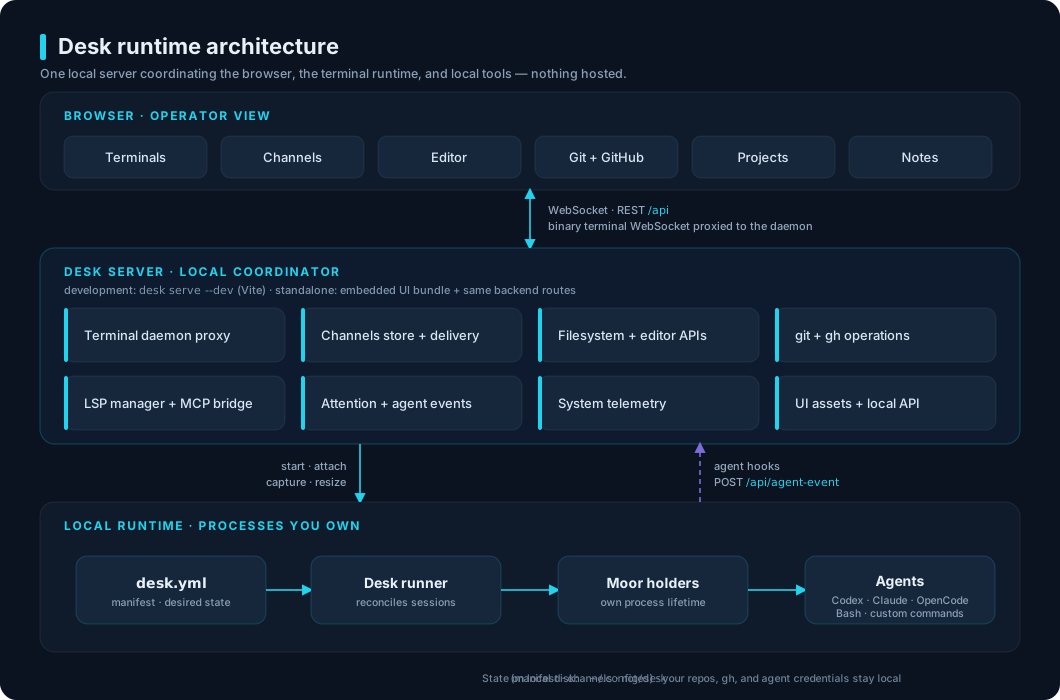
Desk is a local system, not a hosted control plane. The server runs on the same
machine as the code, Moor sessions, credentials, and agent CLIs. The browser is
an operator view over that local runtime.
## Runtime components
 ## Ownership boundaries
### Manifest
`~/.config/desk/desk.yml` describes desired state:
- projects and working directories
- groups and cell layouts
- sessions and agent kinds
- agent profiles, and which profile each session runs under
- custom commands
- permission bypass settings
- resume identifiers
- UI settings
Desk writes the manifest atomically when you edit sessions or layout from the
UI.
### Moor and the terminal daemon
Moor owns process lifetime. Every configured session has a durable `sessionId`
and a private control socket. The server supervises one terminal daemon, which
reconnects to live holders after a restart, provisions missing sessions,
generation-fences terminal traffic, keeps emulator snapshots, and handles input, capture,
resize, restart, and retire. The browser never owns the agent process.
### Server
The server exposes the UI assets and local API. Plain `desk serve` launches the
release-private compiled Bun runtime, which serves the embedded UI without Vite.
`desk serve --dev` explicitly starts Vite and mounts the same backend routes as
server middleware. The CLI does not fall back between these runtime boundaries.
The server also coordinates:
- the supervised terminal daemon and binary terminal WebSocket
- agent surface sessions: native-mode agents run a `desk agent-host` process
in their Moor session that drives the agent SDK; the agent surface broker
relays its transcript events to every subscribed browser and replays history
on reconnect
- filesystem and editor operations
- Git and GitHub operations through `git` and `gh`
- channels storage and delivery
- LSP sessions and MCP access for managed agents
- attention and agent events
- system telemetry
### Browser
The browser renders the operator workspace. It owns layout, selected views,
native agent chats, terminal surfaces, channels panels, editor tabs, project boards, notes, and
theme state. Closing the browser does not stop Moor sessions.
### Terminal transport
The browser uses one binary WebSocket at `/ws/terminal` for the tab's terminal
surfaces. Hiding sends `VISIBILITY false` while retaining the channel; the
daemon revokes its input and resize authority, cancels its queued input, and
suppresses output deltas. Reveal uses the same channel and requests a fresh
emulator snapshot before live output resumes. If revocation races a recovered
Moor client that already copied an ambiguous input tuple, the daemon replaces
that viewer lease before accepting later input; an indeterminate replacement
recovers output continuity without carrying the revoked lease. Only actual
surface removal or transport loss unsubscribes. The
WebSocket bridge routes frames to the terminal daemon; the daemon owns the Moor
holder connections and per-session generation state.
### Agent event hooks
Codex, Claude, and OpenCode are launched with Desk-owned hooks or configuration
that POST typed events to `/api/agent-event`. Desk uses these events for
attention signals, resume capture, channel delivery evidence, and operator
notifications.
## Data locations
| Data | Default location |
| --- | --- |
| Manifest | `~/.config/desk/desk.yml` |
| Channels | `~/.config/desk/channels` |
| Notes | `~/.config/desk/notes` |
| Resume capture state | `~/.config/desk/resume-captures.json` |
| Agent profiles (per-account credentials) | `~/.config/desk/profiles/` |
| Desk's Claude hook settings | `~/.config/desk/claude/settings.json` |
| OpenCode Desk config | `~/.config/desk/opencode` |
| Agent event hooks | `~/.local/share/desk/hooks` |
## What is not centralized
Desk does not copy your repositories, replace GitHub, or proxy agent model
traffic. Agent CLIs authenticate through their own configuration and Desk never
reads or forwards those credentials — but note that a session bound to an
[agent profile](/configuration#agent-profiles) authenticates into a directory
Desk owns (`~/.config/desk/profiles/`), because Desk points the CLI there.
The CLI still writes and reads its own credential files; Desk only decides
which directory they live in. GitHub access is whatever the local `gh` command
can do.
## Next steps
- Read [Workspace model](/concepts-workspace-model) for projects, groups,
sessions, layouts, and durable session identities.
- Read [Agent integrations](/agent-integrations) for Codex, Claude, OpenCode,
Bash, and custom command behavior.
- Read [Security and plugin model](/security-plugin-model) before adding local
runtime extensions.
## Ownership boundaries
### Manifest
`~/.config/desk/desk.yml` describes desired state:
- projects and working directories
- groups and cell layouts
- sessions and agent kinds
- agent profiles, and which profile each session runs under
- custom commands
- permission bypass settings
- resume identifiers
- UI settings
Desk writes the manifest atomically when you edit sessions or layout from the
UI.
### Moor and the terminal daemon
Moor owns process lifetime. Every configured session has a durable `sessionId`
and a private control socket. The server supervises one terminal daemon, which
reconnects to live holders after a restart, provisions missing sessions,
generation-fences terminal traffic, keeps emulator snapshots, and handles input, capture,
resize, restart, and retire. The browser never owns the agent process.
### Server
The server exposes the UI assets and local API. Plain `desk serve` launches the
release-private compiled Bun runtime, which serves the embedded UI without Vite.
`desk serve --dev` explicitly starts Vite and mounts the same backend routes as
server middleware. The CLI does not fall back between these runtime boundaries.
The server also coordinates:
- the supervised terminal daemon and binary terminal WebSocket
- agent surface sessions: native-mode agents run a `desk agent-host` process
in their Moor session that drives the agent SDK; the agent surface broker
relays its transcript events to every subscribed browser and replays history
on reconnect
- filesystem and editor operations
- Git and GitHub operations through `git` and `gh`
- channels storage and delivery
- LSP sessions and MCP access for managed agents
- attention and agent events
- system telemetry
### Browser
The browser renders the operator workspace. It owns layout, selected views,
native agent chats, terminal surfaces, channels panels, editor tabs, project boards, notes, and
theme state. Closing the browser does not stop Moor sessions.
### Terminal transport
The browser uses one binary WebSocket at `/ws/terminal` for the tab's terminal
surfaces. Hiding sends `VISIBILITY false` while retaining the channel; the
daemon revokes its input and resize authority, cancels its queued input, and
suppresses output deltas. Reveal uses the same channel and requests a fresh
emulator snapshot before live output resumes. If revocation races a recovered
Moor client that already copied an ambiguous input tuple, the daemon replaces
that viewer lease before accepting later input; an indeterminate replacement
recovers output continuity without carrying the revoked lease. Only actual
surface removal or transport loss unsubscribes. The
WebSocket bridge routes frames to the terminal daemon; the daemon owns the Moor
holder connections and per-session generation state.
### Agent event hooks
Codex, Claude, and OpenCode are launched with Desk-owned hooks or configuration
that POST typed events to `/api/agent-event`. Desk uses these events for
attention signals, resume capture, channel delivery evidence, and operator
notifications.
## Data locations
| Data | Default location |
| --- | --- |
| Manifest | `~/.config/desk/desk.yml` |
| Channels | `~/.config/desk/channels` |
| Notes | `~/.config/desk/notes` |
| Resume capture state | `~/.config/desk/resume-captures.json` |
| Agent profiles (per-account credentials) | `~/.config/desk/profiles/` |
| Desk's Claude hook settings | `~/.config/desk/claude/settings.json` |
| OpenCode Desk config | `~/.config/desk/opencode` |
| Agent event hooks | `~/.local/share/desk/hooks` |
## What is not centralized
Desk does not copy your repositories, replace GitHub, or proxy agent model
traffic. Agent CLIs authenticate through their own configuration and Desk never
reads or forwards those credentials — but note that a session bound to an
[agent profile](/configuration#agent-profiles) authenticates into a directory
Desk owns (`~/.config/desk/profiles/`), because Desk points the CLI there.
The CLI still writes and reads its own credential files; Desk only decides
which directory they live in. GitHub access is whatever the local `gh` command
can do.
## Next steps
- Read [Workspace model](/concepts-workspace-model) for projects, groups,
sessions, layouts, and durable session identities.
- Read [Agent integrations](/agent-integrations) for Codex, Claude, OpenCode,
Bash, and custom command behavior.
- Read [Security and plugin model](/security-plugin-model) before adding local
runtime extensions.