Give each session its own provider account: create profiles, assign them, and understand what moves with a profile and what does not.
One machine, several accounts. A work Claude account and a personal one; a
Codex account per client; a shared team account you keep away from your own.
Without profiles every agent Desk launches uses whichever account that CLI
happens to be logged into — so the answer to “which account is this agent
spending?” is “the last one I logged in as”, for all of them at once.A profile is a named provider account. Assign one to a session and that
session runs as that account, whatever the others are doing.
Desk does not hold your credentials or log in on your behalf. It points the
agent CLI at a directory of its own:
~/.config/desk/profiles/<profile-id>
for CLAUDE_CONFIG_DIR (Claude Code) or CODEX_HOME (Codex). The CLI then
authenticates into that directory exactly as it would into ~/.claude or
~/.codex, and writes its own credential files there. Desk creates the
directory 0700 and never reads what the CLI puts in it.A profiled launch also unsets inherited provider credentials —
ANTHROPIC_API_KEY and friends — so an ambient key in your shell cannot
silently outrank the account you picked. Choosing a profile means choosing it.
The gear icon in the toolbar. Profiles is the first section.
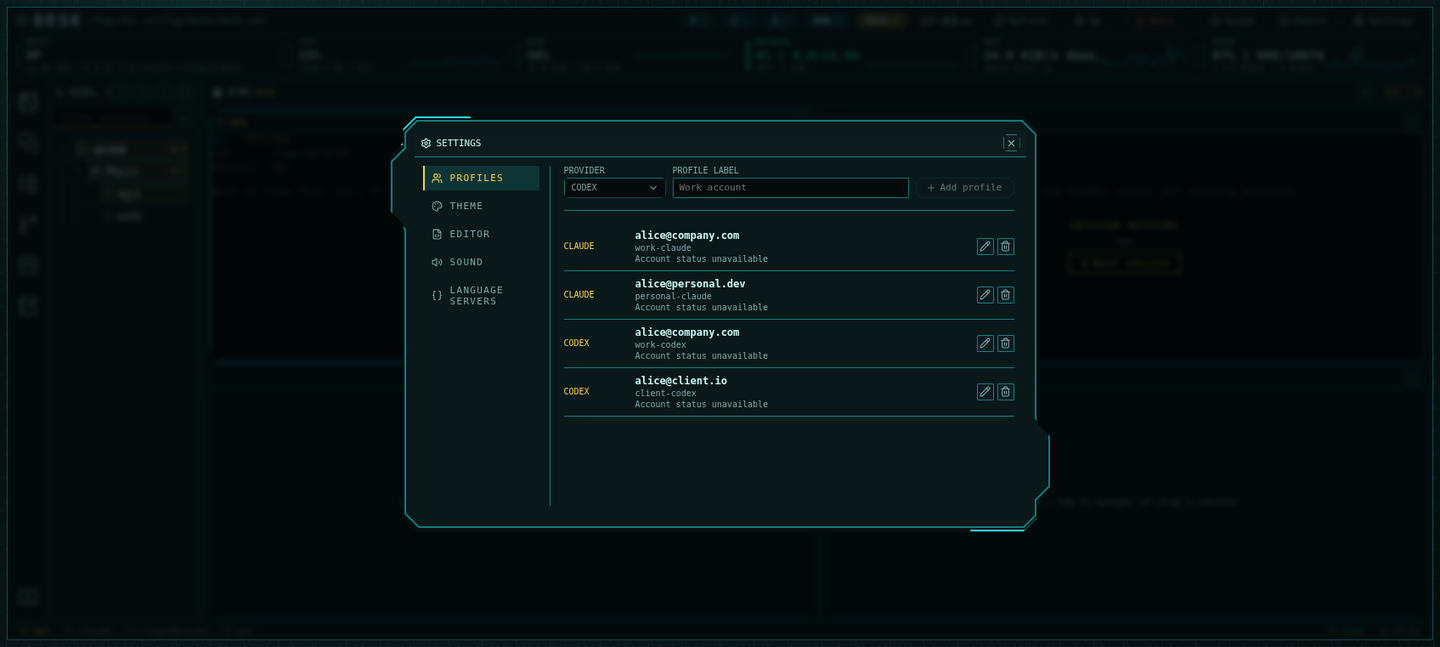
The Profiles settings panel: one row per provider account
2
Add the account
Pick the provider (claude or codex) and give it a label you will
recognise in a dropdown — an email address works well. Desk mints the id
from the label.
3
Sign in inside the profile
A new profile is empty: it has no credentials until the CLI writes some.
Assign it to a session, start that session, and log in there. An ambient
login in your own terminal does not carry over — that is the point.
You can also create one without leaving the session form: the + beside the
Profile picker opens Settings and brings you back with what you had typed
still in place.
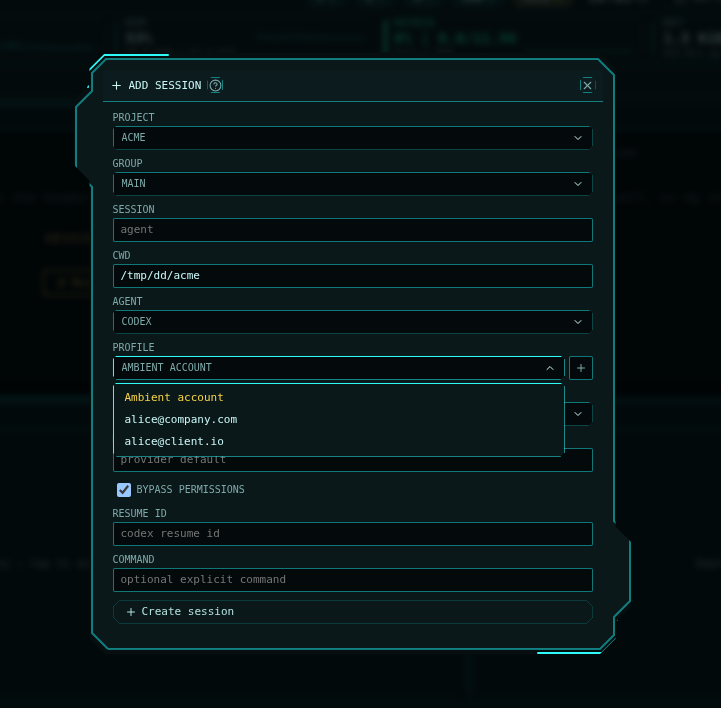
In Add session or Edit session, the Profile row sits directly under the
agent picker:
The session form: the Profile picker lists only accounts for the chosen agent, and + creates one without losing the form
Ambient account — the default. The CLI uses whatever it is logged into.
A named profile — the session runs as that account.
The picker only offers profiles whose provider matches the session’s agent; a
Claude session cannot be pointed at a Codex account. In the manifest the field
is profileId, and a mismatch is a manifest error rather than a quiet
fall-back to ambient — see Configuration.
The third row is the one that surprises people. Claude Code keeps its
conversation history inside its config directory, so a session’s transcripts
live in whichever profile it ran under.
Changing a live session’s profile points it at a different history. The
conversation it was resuming is still on disk under the old profile, but
--resume will not find it from the new one, and the session starts fresh.Decide the account before a long conversation, not during one.
~/.config/desk/profiles holds real credentials. A backup that copies
desk.yml, channels, and notes but skips it restores a workspace whose
agents are all logged out. Back up the whole of ~/.config/desk — see the
backup answer.
The agent asks me to log in again after I assigned a profile. Expected: a
fresh profile has no credentials. Log in inside that session once.My conversation disappeared after switching profiles. It did not — it is
under the previous profile’s directory. Switch the session back to that
profile to resume it, or start a fresh conversation under the new one.The profile picker does not show my account. Its provider must match the
session’s agent. A profile created as codex never appears on a Claude
session.